h1

3 Common Clicker Training Mistakes

July 3, 2009

Clicker training is a fantastic method for taming and training parrots, effective on everything from little budgies and cockatiels to ornery cockatoos. It’s amazingly simple and easy to do, and yields really fast results. The basis of clicker training is positive reinforcement/operant conditioning, and the “secret” of the clicker is that it’s a simple way to communicate. As soon as your parrot starts to understand that “click” means “good, now here’s your reward”, it opens up so many possibilities.

If you don’t know anything about clicker training birds yet, please start by signing up for the Bird-Click discussion group, where you’ll find a wealth of resources in the list and in the files, or by reading the book: Getting Started: Clicker Training for Birds.

If you’ve started clicker training and aren’t seeing great results, check to see if you are making any (or all) of these three common clicker training mistakes.

Mistake #1: Clicking But Not Delivering a Treat

A click is a promise of a treat. If you click for the desired behavior but don’t follow up, you are breaking the implicit contract of clicker training your bird. “Click” always means treat, even if you made a mistake and clicked for the wrong thing.

However, after the behavior is well established and you are sure that your bird understands what you’re asking for, you can phase out the clicker. You should continue to reward the desired behavior, but a treat is no longer required 100% of the time. (In other words, you can treat without a click, but a click always means a treat is coming.) In fact, variable reinforcement can actually be much better at creating a stronger behavior (both bad and good).

Solution: Perfect your clicker timing and always deliver a treat after clicking.

Mistake #2: Not Using a Consistent Marker

As I mentioned in my clicker training myths post, there is nothing magical about the clicker that causes the bird to do what you want, but it has several advantages: it is a distinct and sharp sound that can mark a very precise point in time; it is a consistent noise that always sounds the same; it doesn’t sound like anything else the bird is likely to hear during non-training times. The bird understand that the click has one simple function: to signal that they did the right thing and earned a treat.

You can choose not to use a clicker device as a marker (or “bridge” to the reward), but using a verbal marker is not as precise and could cause training (and learning) to go much slower. If you choose to use the word “good” as a bridge rather than a mechanical click, be conscious of using the same intonation, inflection and timing every time. If your supposed marker is just a combination of long sounds all strung together — “gooooooood. good. gooooood biiiiiirrrrd” — your bird will probably understand that you’re pleased, but have no clue what specific thing is generating the praise, which is the whole point of the marker.

Solution: Use a clicker. If you can’t use a device that makes a distinct, sharp sound, then clicking with your tongue would still be preferable to using a word.

Mistake #3: Using the Wrong Training Reward

The first “trick” you should start teaching your bird is targeting, but even before that the first step of training is figuring out what your bird’s favorite treat is. “Treat testing” involves offering your bird several high-value food items and seeing which one it consistently eats first. Whatever that is, is what your bird prefers most and will probably be willing to work for.

Birds are not like dogs in that their owner’s approval is enough to make them jump through hoops (figuratively or literally). They need to know there’s something in it for them. You don’t have to use food as a reward but it tends to be the easiest to deliver. Things like a head rub could potentially be used as a reward, but only if the bird finds it rewarding enough to work for it. Giving scritches to a bird who barely tolerates them, in other words, is not the correct way to C/T.

The problem with rewards is that we (as humans) tend to focus too much on what we ourselves think should be rewarding, not what actually is to our training subject. Remember: a reinforcer is only a reinforcer if it causes the behavior to increase. I.e., if your bird isn’t eagerly working to get that reward… it’s not much of a reward.

Solution: Conduct treat testing and observe which treats your bird is most enthusiastic about. Remove that item from his daily diet and only use it as a training reward.

Learning to Clicker Train the Right Way

Here you’ve learned what not to do when it comes to clicker training. If you’re interested in learning how to do clicker training the correct way, please join Melinda Johnson’s Bird Click group on Yahoo or get the book: Clicker Training for Birds (from Amazon).

Please also see our previous post: Clicker Training Myths and Misconceptions

h1

Parakeet Training: Budgies Doing Tricks

June 26, 2009

Some people are under the impression that budgies (budgerigar parakeets) aren’t trainable because they are so small. Quite a few people, in fact, think budgies aren’t even real parrots.

Not only are they parrots, check out this guy’s very entertaining comedy act comprised of trick trained budgies. (He’s saying “Allez, allez!” which means “let’s go” in French)

Now that you know just how entertaining budgies can be, don’t you feel sorry for those pet shop parakeets crammed into a small cage who never get let out and never get handled? Budgies, just like the larger parrots, need lots of mental enrichment and activity to keep them happy and well adjusted.

If you’re interested in training your parakeet to perform tricks, check out Melinda Johnson’s fabulous book: Clicker Training for Birds.

h1

How Loud Is a Sun Conure (Redux)

June 15, 2009

Just a quick story: The other night, I got a call from the ACLU asking for a donation to support their investigation of waterboarding at Guantanamo. The whole time, of course, my orange ball of terror is “vocalizing” to express his unhappiness about me being on the phone. At the end of the call, the guy says “Ma’am, I just have to ask. What is that noise? Is that a bird?”. I say, yeah, that’s a parrot. And he says, “that sounds like torture!”.

You heard it first folks: The ACLU considers Stewie to be an instrument of torture! (I wonder if there’s anything in the Geneva Convention about sun conures.)

If you’re considering getting a sun conure and wonder how disruptive it could possible be (all those people warning you about the noise surely must be exaggerating, right?!), try playing this video every time you get on the phone. ;)

h1

Captive Foraging for Parrots

June 8, 2009

Foraging is an important activity for our pet parrots – not only does it keep them entertained and occupied , but it provides them much needed mental enrichment.

In the wild, parrots spend the majority of their waking time looking and working for their food. In our homes, parrots generally have all their food conveniently provided for them in a nice, neat little cup.

While we pet owners are certainly improving our charges’ lives by not exposing them to the dangers of starvation, we also remove from them a fundamental part of what they are designed to do. So why not do both? Why not provide all the food our parrots need to thrive and be healthy, but ALSO provide them with important foraging opportunities.


Hungry Parrot. Photo by Sangudo, used under Creative Commons license.

Hungry Parrot. Photo by Sangudo, used under Creative Commons license.

Foraging is important for pet parrots because, first of all, it gives them something to do. Boredom is the precursor to a lot of behavior problems.

While commercial foraging toys are often pretty cool (and my own birds might actually have most of the foraging toys available for purchase :) ), you don’t actually need to spend a lot of money buying and replacing these products. You may be surprised how easy it is to make your own bird foraging items.

Here are just two ideas for making your own cheap foraging toys:

* Get small, unwaxed Dixie cups. Put a treat inside and crumple the cup together so the treat doesn’t fall out. Your bird will have to open or chew the paper to get at the treat.

* Find some medium-sized rocks, wash and dry them thoroughly, then put them in a bowl with some treats. Your bird will need to move or work around the stones to reach the treats.

See? How easy is that? These are just some examples to show you that providing foraging activities doesn’t need to be expensive, and to get spur some creative brainstorming on your part. Once your birds learn to forage, you can even make them forage for all their food if you want.

There’s a great blog of LiveJournal that’s all about promoting foraging ideas for parrots: http://community.livejournal.com/captiveforaging. The Captive Foraging for Parrots blog includes reviews of foraging toys, instructions for making your own foraging ideas, and photos and videos of parrots engaged in foraging. Check it out for inspiration.

h1

Conure Cuteness Overload

May 19, 2009

You couldn’t get any cuter if you tried!

h1

2009 Endangered Species Day

May 15, 2009

“Happy” Endangered Species Day? Well, there isn’t a lot that’s happy about disappearing biodiversity, but in 2006, the U.S. Congress created Endangered Species Day to celebrate wildlife – and we should certainly celebrate increased awareness about endangered species. Endangered Species Day falls on the third Friday of every May.

So, today would be a good day to get involved with the World Parrot Trust’s work to save endangered parrots around the world. Click the banner below to see what you can do to make a difference.

World Parrot Trust

p.s. Since a lot of captive parrot species are actually endangered in the wild, let’s also remind our legislators that banning the breeding and transfer of non-native animals is a pretty dumb idea too.

h1

How to Get a Parrot to Go Back Inside His Cage

May 13, 2009

I frequently see people struggling with getting their bird back in its cage. I adapted one of my recent BirdBoard responses into a blog post.

How do you get your bird to go in its cage? My parrot always puts up a fuss and runs/flies away when it’s time for him to go back in.

Look at the situation from your bird’s point of view.

You really have to make it worth it to them if you want them to go inside without a fuss. Imagine it was you being locked up… wouldn’t you fight to stay out if being inside your cage meant no more attention, no more playtime, no more fun?

Mika Playing in Her Cage

Mika Playing in Her Cage

A quick digression: The most important thing you need to do (regardless of whether you have trouble getting your bird to go back inside) is to make sure the cage is a fun and safe place.

The cage is your parrot’s home and probably where he spends a good part of his day — it should go without saying that your pet parrot should have as much out-of-cage time as possible (at least a few hours a day), but inside the cage is the safest place for him when he can’t be supervised (when you’re at work) or it’s not safe for him to be out (for example, when you’re cooking). In addition to food and fresh water, the cage should have plenty of space to move around in, plus a variety of toys, perches and enrichment activities.

Your bird’s cage should be situated near where the family activity is, but in a location where he can feel safe (e.g., against a wall, not directly in front of a window). Being inside the cage should never feel like punishment.

But even if your parrot’s cage is the birdie equivalent of Disneyland, being outside — with YOU — is still going to be much more appealing to most pet birds.

So, there are a couple things I do to insure I don’t have to fight with my birds to get them to go inside:

1) Reinforce random step-ups. I give them a treat for stepping up and then put them back down. I do this repeatedly throughout the day. The purpose is to pair step-ups with treats (reward) and show them that a step-up doesn’t necessarily interrupt whatever they were doing before. If they get to step right back off, it costs them nothing and they even get a treat. Only rarely does “step up” equal going inside the cage.

2) Have them go inside and then let them come back out a few seconds later. This teaches them that going inside doesn’t mean that the fun ends right away. Neither does going in the cage mean that I’m leaving. I think a lot of birds don’t like going inside because they know it means their person is leaving them for the next few hours, so I make sure they get a bit of inside the cage time when I’m sitting right there next to them, still paying attention to them. That way inside-time doesn’t equal me being gone or them not getting any attention.

3) Put a very special treat inside their cage that they ONLY get when it’s time to go inside. Sometimes they can come back out when they’re done, but they only get to eat it inside their cage. Nutriberries work like magic in our house. In fact, 99% of the time, I put the treat in their cage and they run inside by themselves. I don’t even have to put them inside; I only have to close the door behind them. Being inside the cage might not be the best thing ever, but neither is it a terrible thing since they get to associate it with a very special treat.

Magic ———->

The important thing, as far as my approach, is that they get to choose to go inside. Having the choice makes it much more palatable for them. Also, I make sure that for them doing what I want isn’t always followed by something not nice. Otherwise I know they’d stop cooperating. (Think about it this way: if every time your boss said “can you come in here?” you got yelled at, wouldn’t you be much more reluctant to go over there? But if going into his office usually meant something nice, you’d be much more eager, right?)

FWIW, they didn’t start off being this cooperative. It took some training, so don’t be discouraged if it doesn’t work right away. You might also want to try target training to help the process along.

p.s. Mika blogged about why she goes back inside her cage a few months ago. She doesn’t realize that she’s constantly taking part in training, and that’s part of the trick: she thinks it’s all her idea. Shhhh ;)

p.p.s. Slightly off topic, but not really: Below a great video of someone using clicker training to introduce their  African Grey to a new travel carrier. Notice how the trainer doesn’t rush the CAG and lets her explore the cage on her own terms. They also do a great job ”treating for position” (You always want to click for the behavior, but place the treat in a position that reinforces continuation of that behavior.)

Want detailed instructions on how to train your parrot to get in his travel cage? I recommend Barbara Heidenreich’s short training video for details on how to teach your parrot to enter and exit a carrier.

h1

The Work of the Alex Foundation Continues – Please Help

May 4, 2009

In Irene Pepperberg’s book Alex & Me — Pepperberg’s story of how a small bundle of feathers humbled a scientific community and showed everyone just how smart parrots really are — she writes: “How much impact could a one-pound ball of feathers have on the world? It took death for me to find out.”

When he died in 2007, his obituary in the world’s most esteemed news publications showed how far avian research has come — this was a bird eulogized alongside political leaders and celebrities. He broke all the preconceptions the world had about what happened inside a bird’s brain, and his death broke our hearts.

But Dr. Pepperberg’s work continued. After all, theirs was a partnership; while Alex was a media darling, it was Irene and Alex together who made those breakthroughs. And their research is not done. You may not know Griffin and Arthur, but they are continuing Alex’s important work, making new breakthroughs in avian language studies.

Check out this TV special featuring Dr. Pepperberg and Griffin:

Extraordinary Animals: Genius Birds

That’s why The Alex Foundation still needs your support. And right now, your donation to The Alex Foundation can count double! A generous donor is offering a matching gift for all donations of over $50 to Dr. Pepperberg’s foundation to support their continued research.

Visit http://www.alexfoundation.org/index2.html for details and to make your donation. The Alex Foundation also asks that you help spread the word about the matching gift, so please feel free to link to this post, to their website directly, and to blog, tweet or email the parrot lovers in your network.

Please donate today (the matching gift expires June 30).

h1

Parrots at the National Zoo

May 3, 2009

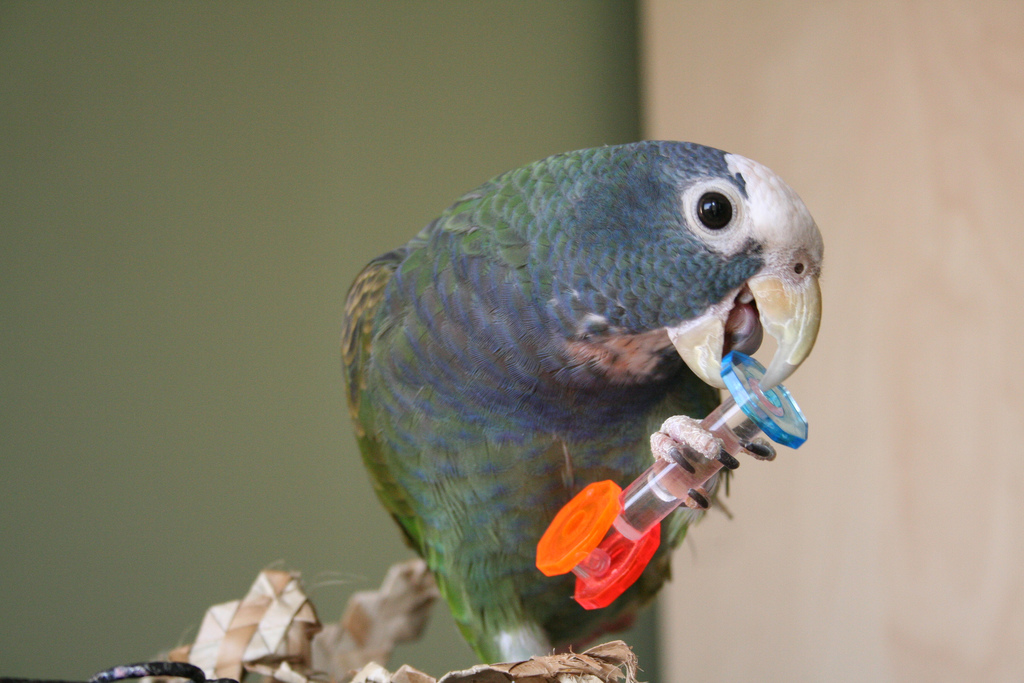
Of course there are parrots at the National Zoo, but yesterday you could also have found a sun conure named Stewie and a White Capped Pionus named Mika at the zoo in DC. That’s because the Smithsonian was hosting a Bird Fest this weekend that included games, performances and exhibitors — including a booth by Phoenix Landing.

At the booth, Phoenix Landing volunteers LeighAnn and Carl showed off their African Greys Pepper and Franco and talked to passers-by about the good work our nonprofit parrot adoption and welfare organization does. I think I also gave variations on my spiel several dozen times, passed out literature and told everyone who came up to Stewie and said “Oh, how beautiful!” that they’re looking at “pound-for-pound, the loudest thing you’ll ever meet.” And if Stewie was being cooperative, he’d let out the same loud shriek they’d been hearing from all across the fair. Almost all the kids would literally flinch or jump the first time they heard it up close. :)

Some of the best questions/comments from the day included:

Man pointing at Stewie authoritatively: He looks like a cross between a parrot and a parakeet.

Several people, noticing Pepper’s tail: I saw this bird last year, but she didn’t have that red tail. I would’ve noticed that.

Teenage girl, looking directly at the birds from 6 inches away: Are they real? (No, they’re robots)

Like a total dolt, I forgot to bring my camera, so I can’t show off any pictures of the birds at the zoo (or the Orangutan who climbed overhead), but it was a fun outing. If Phoenix Landing invites me to join them again next year, I’ll be sure to post photos of Bird Fest 2010 next time around.

h1

HR 669: Huge Implications for Parrot Owners

April 22, 2009

I’ve refrained from saying much about HR 669, The Nonnative Wildlife Invasion Prevention Act, currently being reviewed in the U.S. House of Representatives. Legislation rarely is what it seems on the surface and a lot of misinterpretation (willful and otherwise) often makes the rounds before the real facts shake out.

However, the more I read about HR 669 the more alarmed I am about the implications. On the surface, the bill aims to prevent environmental damage by invasive species — and who can be against that, right? — but apparently the bill has HUGE implications on those who share their lives with “exotic” animals like rodents, tropical fish, and… parrots! (I.e., Under this bill, I couldn’t move across state lines with my birds. And if I die before them, I couldn’t make provisions to send them to Phoenix Landing; they’d need to be euthanized!)

This post by GrrlScientist does a great job dissecting the contents of the bill: HR 669: The Nonnative Wildlife Invasion Prevention Act.

The above link is worth checking out. While it doesn’t seem like the bill is going to make its way out of committee (general consensus is that it is SO poorly written that it’s laughable), I think we need to stay alert about this type of legislation. As recent economic news has shown us, most legislators don’t even read the bills they pass, much less think through all the unintended consequences — so when something like HR 669 gets introduced, we need to pay attention and let our representatives know so it doesn’t slip through the law-making process by mistake.

Take Action!

p.s. If you’re a PETA-type extremist who thinks all pets would be better of euthanized than bred in captivity, and therefore think I’m evil for having parrots, please don’t bother leaving a comment. I won’t put up with it here.